
When I first heard about the Dex Camera, my first thought was, Oh, this is clever.
Dex is one of those innovative tools that won’t be a five-minute hit. Instead, it is a tool that makes learning a new language fun, interactive and part of everyday life.
My second thought, as a teacher, was: But does it actually help children learn?
I’ve spent a lot of my working life around children and education. I’m a teacher, school governor and parent, and I’ve worked with thousands of children. I’ve taught in classrooms, planned lessons, watched children switch off when something doesn’t engage them and, equally, watched what happens when you find the right way into a subject.
I’m probably a little harder to impress than the average parent when someone tells me they’ve created an “innovative” learning tool that will teach new vocabulary.
But Dex genuinely caught my attention.
Not because it’s packed with technology.
Actually, quite the opposite.
It’s because the technology is designed to get children looking up and exploring the world around them. This is unique as it encourages real-life exploration, and I know that children learn best when they discover things for themselves.
And the more I thought about it, the more I could see how much potential that has for language learning.
Let Me Explain What I Mean
Imagine you’re out for a walk with a child who is learning Spanish.
You see a dog.
Normally, you might say, “Look at that dog.”
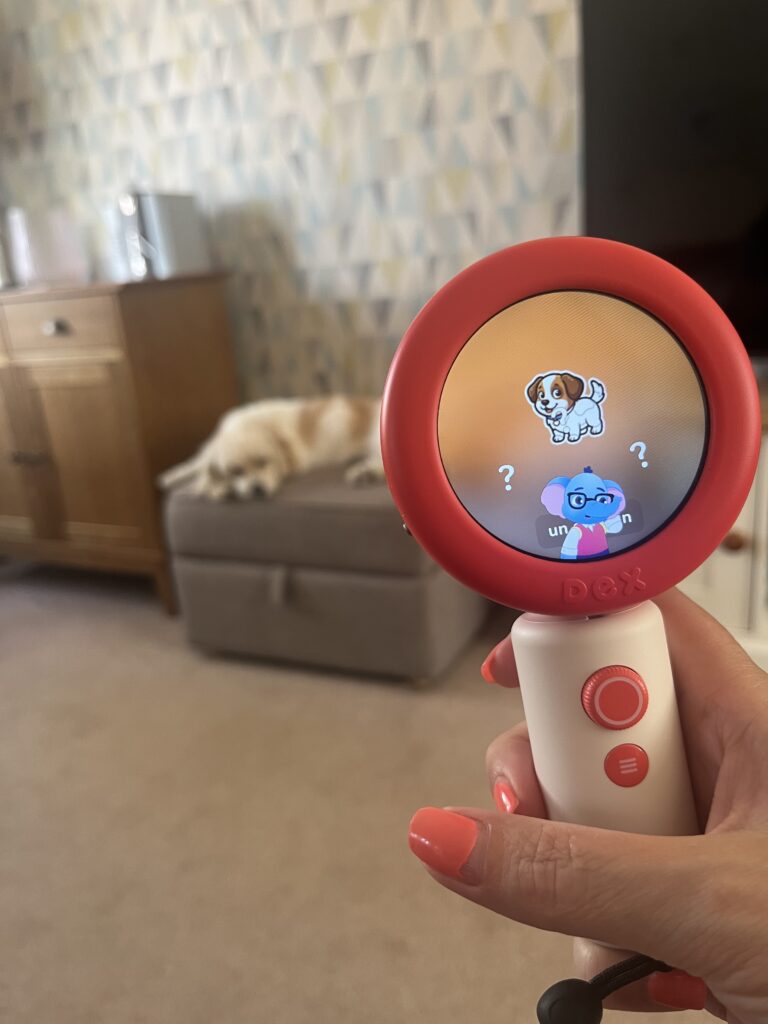
With Dex, that same moment can become a little language-learning opportunity.
The child can use the camera to explore what they’re seeing and discover the word in their new language.
Then you keep walking.
You see a flower.
A tree.
A bicycle.
A bird.
Suddenly, you’ve collected a handful of new words without ever sitting down for a lesson.
And that is what I really like about it.
The real world becomes the classroom.
This Is Where My Teacher Brain Kicked In
I couldn’t help looking at Dex through my teacher eyes.
I’ve always believed that children learn best when they are actively involved in the process.
There is a huge difference between telling a child something and allowing them to discover something for themselves.
That’s why I immediately liked the idea of Dex.
The child is in control.
They decide what to photograph.
They decide what interests them.
They get instant feedback.
They can then revisit what they’ve discovered.
That makes the experience much more interactive.
It isn’t simply:
Teacher says → child repeats.
It’s more like:
Child notices → child explores → child discovers → child remembers.
And I think that is a really powerful way to approach learning.
Real-Life Exploration
I gave this to my nephew to try out. I didn’t tell him how to use the Dex Camera – I only asked which language he would like to learn.
I wanted to see if he could intuitively master using the camera without me telling him what to do and, as I thought, he quickly worked it out for himself.
He then spent ages wandering around the house taking photos of different household objects and discovering what they were called in French.
What surprised me was that it didn’t just stop at teaching him individual words – it gradually built on those words and introduced them in sentences, so he was beginning to understand how the language could actually be used.
He was completely absorbed in it, and from a teacher’s perspective, seeing him learn so independently and enthusiastically was probably the best part.
The Scavenger Hunt Is Probably My Favourite Feature
I’m a sucker for anything that gets children moving, so the scavenger hunt really appealed to me.
It takes something that could otherwise be a simple “point and learn” experience and turns it into a mission.
And I think that’s particularly clever for younger children.
Tell a child they’re going to spend 20 minutes learning vocabulary and you might get an eye roll.
Tell them they’re going on a scavenger hunt?
Much more exciting.
The child has a reason to explore.
They have something to find.
And, without necessarily realising it, they’re practising another language.
That’s a win.

And It Isn’t Just About Learning One Word and Moving On
This is another thing I think parents will appreciate. Dex includes activities such as flashcard games, stories and other ways of revisiting vocabulary. That’s important because one of the biggest mistakes we can make when learning is assuming that seeing something once means we’ve remembered it.
It doesn’t. Children need repetition.
They need to encounter words again.
They need to hear them, recognise them and eventually use them.
So I like the fact that Dex can take something a child has discovered in the real world and bring it back into another activity.
The learning doesn’t necessarily end when the photograph is taken.
I Also Like the Instant Feedback
One thing I noticed when thinking about how children might use Dex independently is the instant feedback. Children don’t always want to ask an adult for help. Sometimes they want to work it out themselves.
And as a teacher, that’s something I actively want to encourage. We want children to become independent learners.
If they can try something, get feedback and have another go, they’re learning much more than simply the answer.
They’re learning how to learn.
What About the Parent App?
The parent app is another feature that makes sense to me. We are in an era where we are very aware about screen time and what our children are able to access and how they are using tech. Therefore I like the idea that children can have some independence but parents aren’t completely removed from the experience.
You can see what your child has been exploring and learning, which means you can pick up the conversation afterwards.
And honestly, I think that’s where parents can make Dex even more valuable.
Your child comes to you and says they’ve learned a new word.
Don’t just say, “That’s nice.”
Use it.
Try it at dinner.
Point something out when you’re out.
Ask them the word again tomorrow.
That turns a five-minute interaction with a camera into something that becomes part of everyday life.
It Could Work Brilliantly for Different Ages
Dex is designed primarily with younger children in mind, but I can see children of different ages using it in very different ways.
A younger child might simply enjoy discovering the names of objects.
An older child could use those words to create stories, complete challenges or practise sentences. Imagine taking it on holiday and helping your child speak to locals or restaurant staff because they have learnt some food words. We have just come back from a holiday and I could honestly imagine younger children exploring the hotel with this and able to interact more with the staff. And the custom activities particularly interest me here.
I love anything that allows learning to be adapted to the child.
Because we all know that children don’t learn in exactly the same way.
One child might be fascinated by animals.
Another might love food.
Another might be obsessed with space.
If you can build language learning around what a child already loves, you’re immediately making it more meaningful.
I Can Also See the Appeal for Bilingual Families
Another thing I hadn’t immediately considered was how useful Dex could be for families where more than one language is already part of everyday life.
Learning different languages isn’t always about starting completely from scratch.
A child might understand a language but lack confidence speaking it.
They might hear their grandparents speaking it but use their native language most of the time themselves.
They might be learning another language at school and want extra opportunities to practise.
Having a tool that makes vocabulary part of everyday exploration could be really useful in all of these situations.
It’s the Hands-On Element That Really Sells It to Me
There are so many educational products now that involve children sitting in front of a screen.
And I’m not anti-technology.
Far from it.
Technology can be fantastic when it’s used well.
But I particularly like hands-on experiences.
Children need to move.
They need to explore.
They need to touch things, look at things and make connections.
Dex uses technology to encourage that rather than simply replacing it.
That’s quite a subtle difference, but I think it’s an important one.
How I’d Use Dex at Home
If I had a younger child learning a language, I think I’d make Dex part of ordinary family life rather than setting aside a formal “Dex lesson.”
We’d take it on a walk.
We’d use it on holiday.
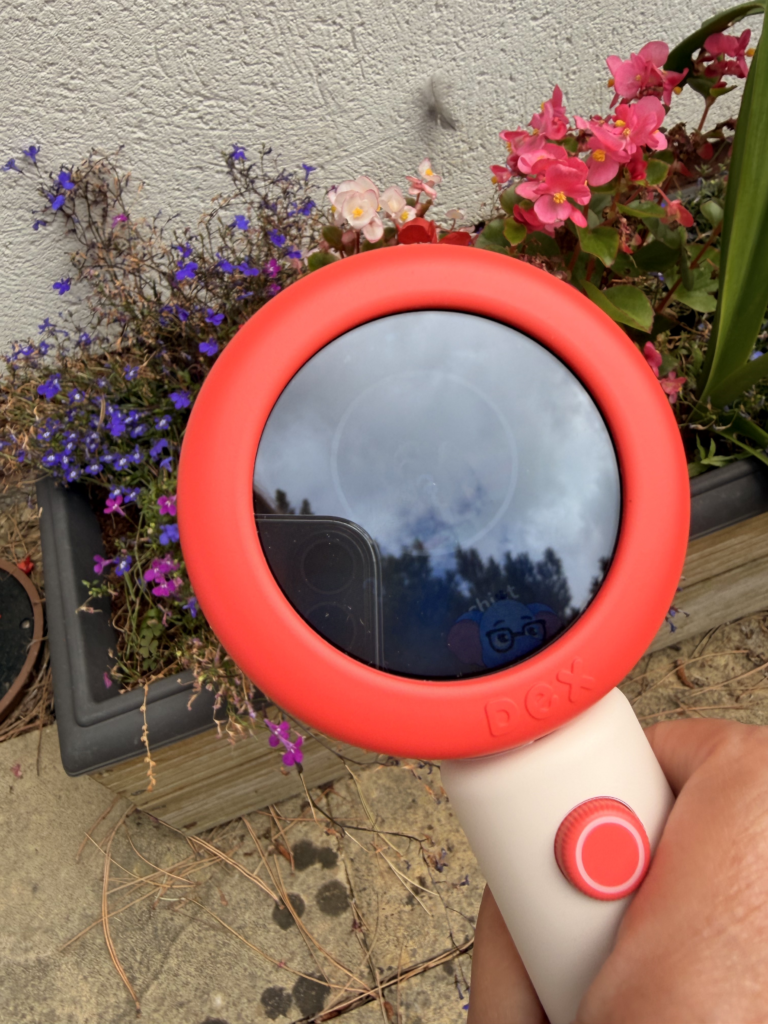
We’d explore the garden.
We’d have a challenge at the supermarket.
We’d see how many words we could discover around the house.
And then, later, I’d ask:
“Do you remember the word you learned for that yesterday?”
That’s where I think the magic happens.
The technology creates the initial interest.
But the repeated use and conversations turn it into learning.
Is It Perfect?
No, and I think it’s important to say that.
It’s still an AI-powered tool, and AI can get things wrong.
I wouldn’t use Dex as a replacement for a teacher, fluent speaker or structured language programme.
But I don’t think those things take away from the concept.
Inside the Box You’ll Find
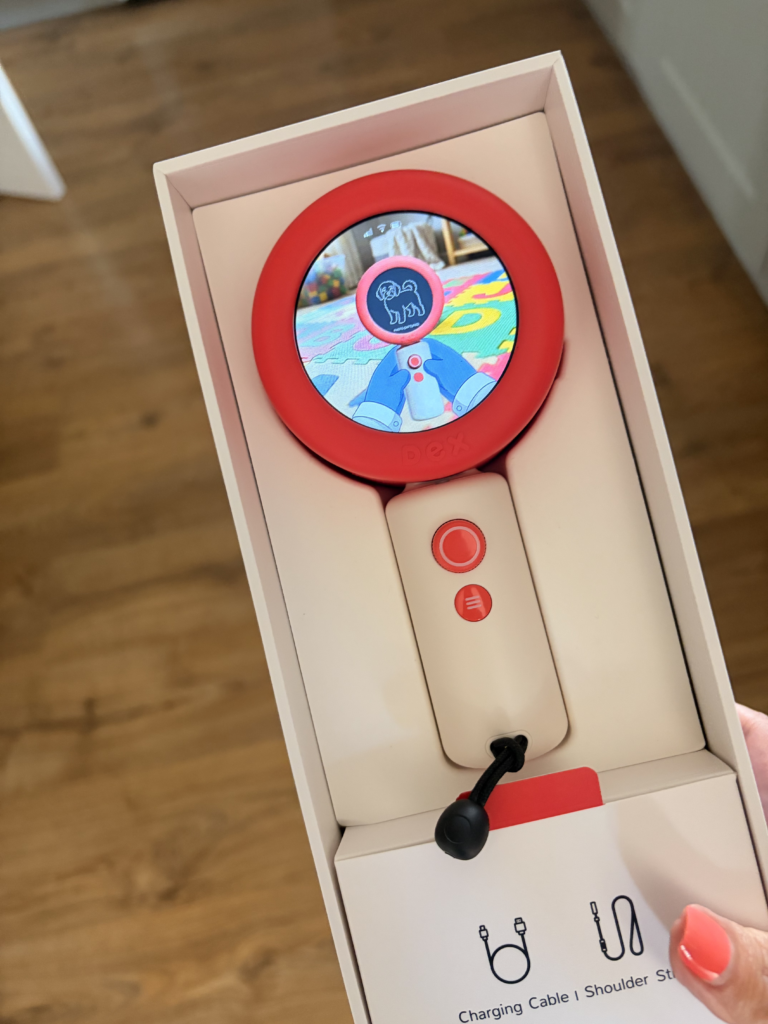
- The Dex Camera – the main child-friendly camera and language-learning device.
- USB-C charging cable – for charging the camera.
- Quick-start information – to help you get the device set up and ready to explore.
- Access to the Dex experience – including its interactive language-learning features, activities and games.
The camera itself is small, lightweight and designed to be easy for children to hold and use.
Once it’s charged and set up, children can start exploring the world around them, taking photographs and discovering new words and sentences in their chosen language.
But something they can discover in the real world.
And that’s why, from a teacher’s point of view, I think Dex is genuinely interesting.
Would I Recommend It?
Yes. If you’re looking for an engaging way to introduce a child to language learning, particularly a child who isn’t going to be thrilled by sitting down with vocabulary cards, I think Dex is worth considering.
My favourite thing isn’t actually the camera. It’s what the camera encourages children to do.
Look around. Be curious. Explore. Ask questions. And discover that learning a new language can happen anywhere.
And after years of teaching, that’s exactly the kind of learning I love to see.
Ready to give language learning a try?
If the Dex Camera sounds like something your family would enjoy, you can get 10% off your order using my exclusive code 10Emma.
It’s a lovely way to make learning a new language feel less like homework and more like something you can naturally build into everyday life — whether that’s taking photos around the house, discovering new words or exploring the real world together.
Use code 10Emma at checkout to save 10% visit the website by clicking here to buy
FAQ for Dex Camera
What is the Dex Camera?
The Dex Camera is a child-friendly language-learning device that uses a camera and AI technology to help children discover new words and sentences in different languages. Children can photograph objects around them and use those real-world experiences as part of their language learning.
How does the Dex Camera help children learn a language?
The Dex Camera encourages children to learn through exploration. They can photograph objects they see in everyday life and discover what they are called in their chosen language. The experience can then build beyond individual vocabulary and introduce words within sentences, helping children understand how language is used.
What languages can children learn with the Dex Camera?
The Dex Camera is designed to support learning different languages. The languages available may depend on the current Dex experience and updates, so it is worth checking the latest information before purchasing if your child has a particular language in mind.
Is the Dex Camera suitable for younger children?
The Dex Camera is designed with children in mind, particularly younger children who may enjoy learning through play and exploration. The simple, hands-on approach means children can discover vocabulary independently rather than relying entirely on formal lessons.
Does the Dex Camera only teach individual words?
No. One of the things that impressed me during my nephew’s experience was that the learning didn’t simply stop at individual vocabulary. The Dex Camera gradually built on the words he discovered and introduced them in sentences, helping him begin to understand how the language could actually be used.
Can the Dex Camera be used for language learning at home?
Yes. I think this is one of its biggest strengths. Rather than needing to set aside a formal language lesson, children can use the Dex Camera around the house, in the garden, on walks, on holiday or even while out shopping.
Does the Dex Camera give children instant feedback?
Yes. The instant feedback is one of the features I particularly like from an educational perspective. Children can explore independently, receive feedback and then continue experimenting, helping to develop both vocabulary and independent learning skills.
Is there a parent app for the Dex Camera?
Yes. The parent app allows parents to see what their child has been exploring and learning. This can also create opportunities for parents to reinforce the language away from the camera by revisiting words and using them in everyday conversations.
Is the Dex Camera a replacement for language lessons?
No. I wouldn’t see it as a replacement for a teacher, fluent speaker or structured language programme. Instead, I’d see it as an additional tool that can make language learning more engaging and give children extra opportunities to practise and explore.
Is the Dex Camera good for children learning a second language?
I think it has particular potential for children learning a second or additional language because it makes vocabulary part of everyday life. It could also be useful for bilingual families where a child understands a language but needs more opportunities to build confidence using it.
Is the Dex Camera worth buying?
For families looking for a hands-on and engaging way to introduce children to language learning, I think the Dex Camera is worth considering. What appeals to me most isn’t simply the technology itself, but the way it encourages children to look around, explore their environment and discover language for themselves.
