
When your child is struggling with Emotionally Based School Avoidance (EBSA), every morning can feel like a battle. As both a qualified teacher and parenting coach supporting families through the teen years, I’ve worked with many parents who feel trapped between school attendance pressures and protecting their child’s mental health.
One of the biggest misconceptions I see is parents being told they simply need to improve attendance — even when their child is experiencing severe anxiety, panic attacks, autistic burnout, or complete emotional overwhelm.
What many families are not told is this:
Section 19 of the Education Act 1996 may give your child the legal right to alternative education provision.
If your child cannot attend school because of EBSA, the Local Authority may have a duty to arrange suitable education.
In this guide, I’ll explain:
- What Section 19 means
- How Section 19 applies to EBSA
- What alternative provision may look like
- Whether you need an EHCP
- How parents can request support
- What evidence helps strengthen your case
What Is Section 19 of the Education Act 1996?
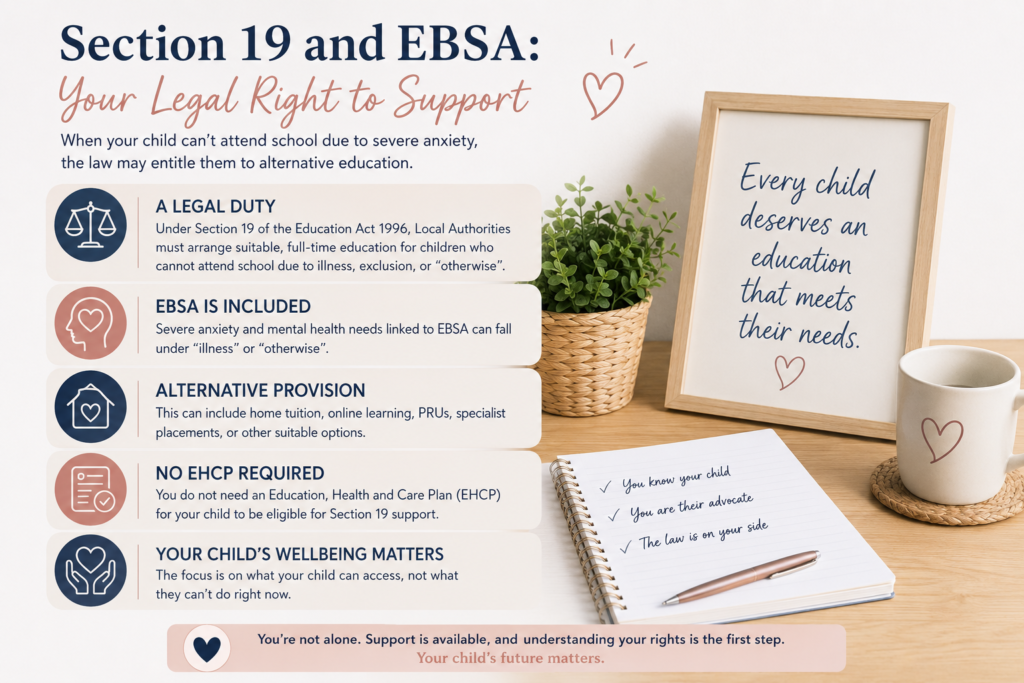
Section 19 of the Education Act 1996 places a legal duty on Local Authorities to provide suitable education for children who cannot attend school due to:
- Illness
- Exclusion
- Or “otherwise”
This education must be:
- Suitable for the child’s age and ability
- Appropriate for any SEND needs
- Full-time where possible (or as much as the child’s health allows)
For families dealing with EBSA, that word “otherwise” is incredibly important.
Can Section 19 Be Used for EBSA?
Yes — Section 19 can absolutely be used to secure alternative education for children experiencing EBSA.
In practice, many children with Emotionally Based School Avoidance are medically unable to attend school because of severe anxiety or mental health difficulties.
As someone working closely with parents navigating school anxiety and attendance challenges, I often see children whose nervous systems are in constant fight-or-flight mode. These are not children “choosing” not to attend school. They are children struggling to cope emotionally.
When school attendance becomes harmful to a child’s wellbeing, Local Authorities have a responsibility to consider alternative provision.
How Section 19 Applies to Emotionally Based School Avoidance
The “illness” and “otherwise” clauses within Section 19 can include:
- Severe anxiety
- Panic disorders
- Depression
- Trauma responses
- Autism-related burnout
- EBSA linked to unmet SEND needs
If medical professionals, therapists, CAMHS, or other evidence indicate that a child cannot currently attend school safely, the Local Authority must consider suitable education outside of mainstream school.
This is especially important because many parents are wrongly told that absences linked to EBSA are simply “poor attendance” or “school refusal.”
In reality, EBSA is a recognised mental health and emotional wellbeing issue.
What Alternative Provision Can Be Offered Under Section 19?
Alternative provision should meet the child’s individual needs.
Depending on the situation, this may include:
1-to-1 Home Tuition
Many children with EBSA initially cope best with tutoring at home in a low-pressure environment.
Online Schooling
Remote learning can reduce anxiety triggers while allowing children to continue accessing education safely.
Pupil Referral Units (PRUs)
Some PRUs provide smaller class sizes, emotional support, and more flexible learning environments.
Specialist Therapeutic Placements
For children with complex SEND or mental health needs, therapeutic educational settings may be more appropriate.
Reduced or Blended Timetables
Some children gradually rebuild confidence through a combination of home learning and limited school attendance.
In my work with parents, I often encourage families to focus on what their child can currently manage emotionally — not simply what the system expects them to tolerate.

Do You Need an EHCP for Section 19 Support?
No — and this is one of the most important things parents need to know.
You do not need an Education, Health and Care Plan (EHCP) for your child to receive Section 19 support.
The Local Authority’s duty exists regardless of whether a child has:
- An EHCP
- A diagnosis
- CAMHS involvement
- Formal SEND recognition
Unfortunately, many parents are incorrectly told they must wait for assessments or diagnoses before support can be arranged.
That is not what the law says.
If your child cannot attend school because of illness or otherwise — including severe anxiety and EBSA — the Local Authority still has a legal duty to provide suitable education.
What Evidence Helps Support a Section 19 Request?
Strong evidence can make a significant difference.
Helpful documentation may include:
- GP letters
- CAMHS reports
- Therapist recommendations
- School attendance records
- Educational psychologist reports
- Emails showing distress around attendance
- Evidence of panic attacks or emotional dysregulation
- SEND documentation
Parents should also keep detailed notes about:
- Morning anxiety
- Physical symptoms before school
- Emotional exhaustion after school
- Sleep disruption
- Failed reintegration attempts
As a parenting coach supporting teens through school-related stress, I always encourage parents to trust what they are seeing at home. You know your child best.
What If School Says Your Child Is “Refusing” School?
This is one of the hardest parts of EBSA for many families.
Parents are often left feeling blamed or judged when attendance drops.
But EBSA is not simple defiance.
Children experiencing emotionally based school avoidance are often highly anxious, emotionally overwhelmed, and unable to access learning safely within the school environment.
The focus should not simply be on attendance percentages.
The focus should be on understanding the barriers preventing attendance.
How to Request Section 19 Support
Parents can write directly to the Local Authority requesting alternative provision under Section 19.
Your request should include:
- Details of your child’s difficulties attending school
- Medical or professional evidence
- The impact on your child’s mental health
- Why mainstream attendance is currently unsuitable
- A formal request for suitable education under Section 19
It is also helpful to request all communication in writing.
Why Early Intervention Matters for EBSA
In my experience working with teens and families, the earlier support is put in place, the better the long-term outcomes tend to be.
Without appropriate intervention, EBSA can lead to:
- Escalating anxiety
- Loss of confidence
- Social isolation
- Depression
- Family stress
- Long-term disengagement from education
Children need support, safety, and understanding — not pressure or punishment.
Appropriate alternative provision can help children continue learning while protecting their mental health.
Final Thoughts on Section 19 and EBSA
If your child is struggling with Emotionally Based School Avoidance, you are not alone — and there are legal protections available.
Section 19 of the Education Act 1996 can be used to secure alternative education for children who cannot attend school because of severe anxiety, mental health difficulties, or other barriers linked to EBSA.
Most importantly:
- Section 19 can apply to EBSA
- Mental health difficulties count
- Local Authorities have legal duties
- Alternative provision can be arranged
- An EHCP is not required
As both a teacher and parenting coach working with families through the teen years, I know how emotionally exhausting this journey can feel. But understanding your child’s rights is often the first step toward getting the right support in place.
Frequently Asked Questions About Section 19 and EBSA
Can anxiety qualify for Section 19 support?
Yes. Severe anxiety and mental health difficulties can fall under the “illness” or “otherwise” categories within Section 19.
Does my child need an EHCP for alternative provision?
No. Children do not need an EHCP to receive Section 19 education support.
Can children with autism and EBSA access Section 19?
Yes. Many autistic children experiencing school-related anxiety or burnout may qualify for alternative provision.
What happens if the Local Authority refuses support?
Parents may need to seek legal advice, SEND advocacy support, or challenge decisions formally in writing.
